

Do I Really Need To Unplug My Aquarium While Cleaning
Every fish tank requires maintenance; some require more others, just whether it's a h2o change every week or topping a tank off every calendar month, the success of most tanks is the reflection of how much time y'all requite them. Regular h2o changes, substrate vacuumings, and filter media replacements are just some of the nearly common steps you volition need to take to keep your tank stable. Luckily, these processes aren't hard and usually lead to a thriving ecosystem.
Keep reading to find out why you need to clean your betta fish tank and how to make sure you're doing it right!
The basics
It might seem like betta fish are one of the easiest pets you lot could own, simply like whatever other brute, they still require care and budget. Cleaning up afterward betta fish isn't equally simple as cleaning up after a dog or true cat though, and needs some do to get right. But first, you demand to understand why a clean tank is necessary in the first place!
Why do you need to clean your betta fish tank?
For the most function, fish tanks are self-sufficient ecosystems that run themselves with the aid of nitrifying leaner, converting ammonia to nitrates. In social club to understand why you need to clean your tank, you need to place your small enclosed ecosystem in the context of your betta'south natural surroundings in the wild.
In wild aquatic habitats, there is a constant importation and exportation of nutrients/minerals, wastes, and gasses, due to flowing h2o, sediments, evaporation, weather, and other flora and fauna. In our small piddling fish tanks, there is no input other than what we introduce into the system, and export is typically handled by filter media and/or plants and corals. Hobbyists accept solved this trouble by performing weekly or biweekly h2o changes.
Water changes permit for new nutrients/minerals to enter the system while getting rid of those that accept built up over fourth dimension. For example, nitrates. Nitrates are constantly being created by fashion of the nitrogen cycle that converts ammonia to nitrite to nitrate. As nitrifying bacteria does non process nitrate, it is left to build up in the tank and can become toxic at extreme levels. While nitrates are uptaken by plants and corals, hobbyists will usually still demand to perform water changes to keep the nitrates in their tanks from building up.
Similarly, water changes help replenish oxygen levels within the tank. Usually surface water agitation, by manner of a filter, air rock, or powerhead, is used to increase gas exchange. Water changes help create movement through the tank and innovate new gases through the new h2o. As pH is related to how much carbon dioxide in the tank water, water changes can also help stabilize pH and/or increment pH if needed.
How often do you lot need to clean your betta fish tank?
While all these elements seem similar a delicate residuum, h2o parameters in mature tanks stay relatively stable when water changes are regular and aquarium maintenance is maintained. That being said, how oftentimes you lot will need to make clean your betta fish tank is up to the tank itself.
How often you need to practice a water change depends on the size of the aquarium, filtration, water circulation, bioload, feeding habits, and much more than. In general, it is recommended to practice 10-25% water changes every week or every other week. Some hobbyists are able to get by but doing monthly water changes, while others don't do whatever at all. This is entirely based on the amount of waste matter produced and uptaken in the aquarium.
If your betta tank starts growing algae, it is ordinarily recommended to increase the frequency of water changes to help remove excess nutrients; at the aforementioned fourth dimension, it is besides important to search for the cause of the backlog nutrients. Algae is usually the issue of high nitrates or phosphates and too much lighting and/or the wrong light spectrum.
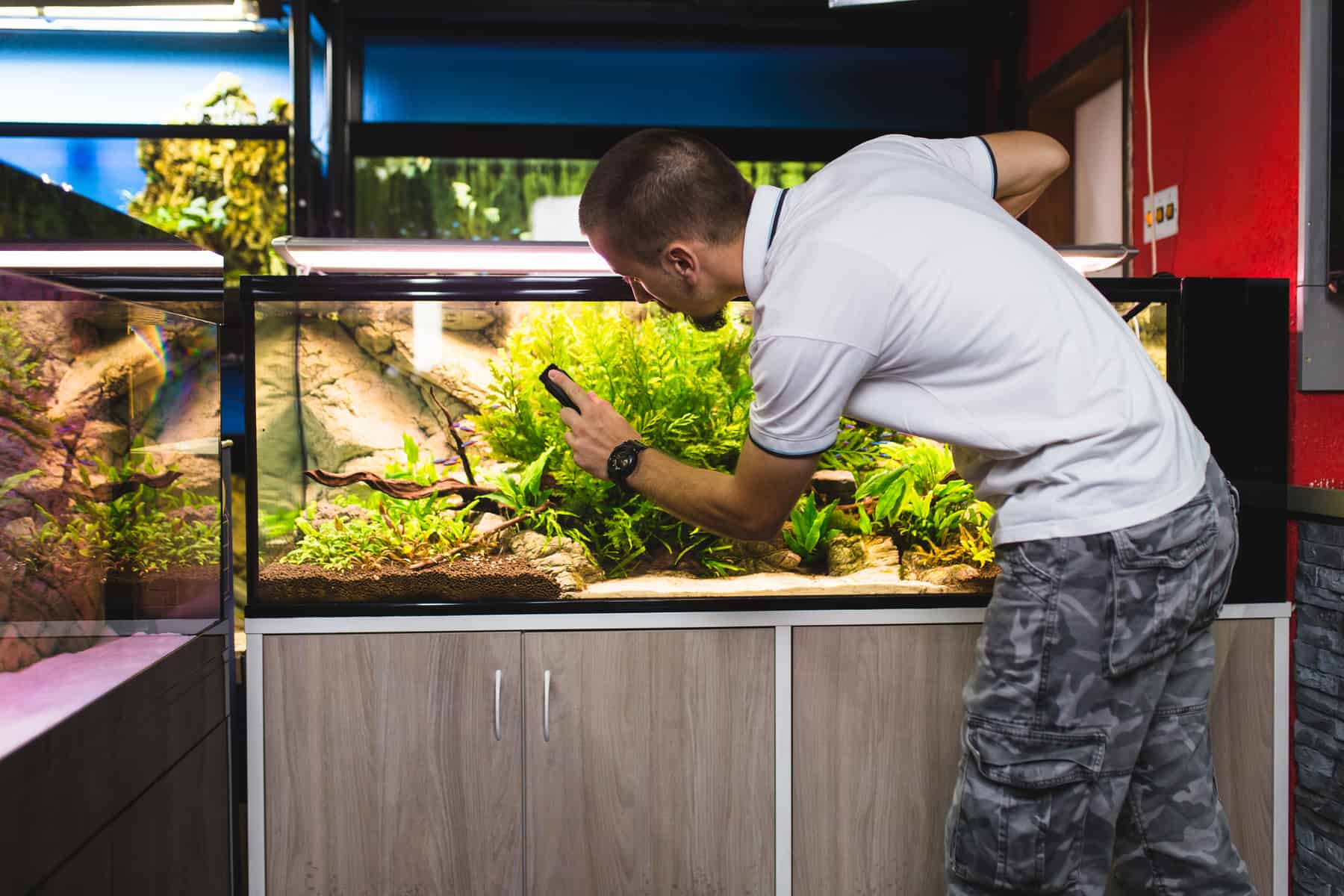
How to clean your betta fish tank
So it's fourth dimension for your first routine tank cleaning! Information technology tin be a little scary, only after a few tries, yous'll be able to perform a water modify in a short amount of fourth dimension with little to no hiccups along the way! Here are the easy steps involved with cleaning your betta fish tank (lodge may alter with personal preference):
- Prepare new water. It is usually recommended to take the new tank water prepared and ready to go when you become to make clean your betta tank. This will mean heating the water to match the temperature of the tank and adding de-chlorinator. At the aforementioned time, you may also unplug any equipment in the aquarium and so that they don't burn out and so there is no danger to yourself.
- Start a siphon. Once your water is set and all equipment is safely turned off, it is time to get-go taking water out from the tank. This can be washed by using an aquarium vacuum or airline tubing. Alternatively, you may also utilise a cup to slowly remove portions of water.
- Scrub for algae. While you are siphoning water, you may also have the time to scrub the sides of your aquarium, removing any algae that you can come across. This is and then that if larger pieces of algae come off, they will be sucked up and removed from the tank every bit well.
- Vacuum the substrate. It is as well a expert idea to use this time to vacuum and clean the substrate. Cleaning the substrate will go along dead zones and detritus from piling upwardly, which can oftentimes lead to algae issues or other excess nutrients. Overturning the substrate will besides assist with gas exchange.
- Waft hard-to-reach places. If you have decorations that are close to the wall of your tank or areas where water menstruation isn't skillful, brand sure to gently waft h2o into those areas to flush out debris. Many hobbyists utilise turkey basters for the same effect. It may also be a skillful idea to vacuum the surface of the substrate or utilise a fish net to catch loose particles afterward.
- Wash/supersede filter media. Once you accept a good amount of tank h2o removed from the tank, it is best to take the time to clean and supplant filter media. Spent tank h2o can be used to rinse sponges and pads free of debris; never use tap water for this process as it will kill much of the beneficial bacteria populating those surfaces. Some hobbyists choose to await a day or ii after they have performed a water change to clean and supervene upon filter media; this way, all of the debris that had been kicked upward does not get direct into a clean sponge.
- Finish siphon. Once y'all take cleaned the tank equally much as you tin (while not disturbing also much besides fast), you may stop the siphon. Make sure to not leave your tank empty for too long as whatsoever areas that are exposed to air for besides long will starting time to die off.
- Refill the tank. Once yous have finished scrubbing the sides of the tank, vacuuming the substrate, wafting hard-to-reach places, and washing/replacing filter media, it is fourth dimension to refill the tank with the water that you lot made. While betta fish should be able to withstand piffling changes in water conditions, it is best to become slow with this process. Make sure to double-cheque the temperature and gradually refill the tank with the remaining h2o. Once done, equipment may be turned back on.
The best time to practice aquarium maintenance is during water changes. It is recommended to avoid putting your hands in the tank as much as possible otherwise, as each time that you do, you take a chance contagion and stressing out your livestock. However, if you're struggling with algae, you might have to regularly reach within the tank at other times.
Note: Call up that betta fish are tropical fish and require tropical h2o temperatures. New aquarium water must match the temperature in the tank in club to not stress out your aquarium inhabitants. Room temperature water can really stress out your fish if it is also hot or as well common cold!
Too, remember that your heater will exist unplugged while performing water changes so room temperature tin can outset to affect the temperature of your tank depending on how long the process takes.
Products to avoid when cleaning your betta fish tank
All that water changes crave is a way to remove and add water and de-chlorinate; no other chemicals are needed. Still, when setting up a tank, about beginners want to clean their tank before they fill information technology upwardly with water. Too many times, they use soap to clean the tank. Lather and detergent will inevitably lead to a dead betta fish.
Even small-scale amounts of soap or detergent will affect your betta fish. In short, soap interferes with gill functions, leaving your fish to drown. This tin happen very fast but is easily preventable. If you take an aquarium, or any other aquarium equipment or accessories, that yous know has been in contact with soap, quickly remove upwards to fourscore% of the water and refill the tank; you lot want to dilute the soap as fast as you lot can. Echo this process several more times; adding activated carbon may likewise assistance remove the soap.
When cleaning an established tank, it is always all-time to rinse every bit much every bit you tin off with spent aquarium water. Still, when starting a new tank, you may find yourself wanting to clean the tank before filling information technology with water. Luckily, at that place are a few products that are much less harmful than soap and simply equally piece of cake to go.
Diluted white vinegar is a practiced alternative for cleaning most aquarium accessories and decorations. Simply mix a ane:1 of water and white vinegar and rinse and/or soak. Make sure to rinse the objects that were cleaned a couple of times to ensure that there is no vinegar residue; while unlikely if rinsed well, vinegar can as well impact pH levels.
When in doubt, but use warm water. This is particularly true for new setups where you are still able to dry off surfaces so that tap water doesn't enter your system.
Annotation: Remember that this applies to any equipment that is also used to make clean your aquarium, similar the aquarium vacuum and any buckets!
Why is your betta fish tank so muddy?
There are a few reasons why y'all might detect that your betta fish tank is specially dingy. Some of these possible causes are overfeeding, poor aquarium maintenance, and poor source water.
Overfeeding
Betta fish are pretty like shooting fish in a barrel to overfeed equally they're e'er willing to accept food. It is of import to take a ready routine with a fix corporeality of food ready to go in order to prevent overlapping feedings. All nutrient that is uneaten should be removed from the tank within a few minutes of feeding and food rationing should then be reconsidered.
Overfeeding can quickly lead to algae problems if left untreated. It is all-time to regularly clean the substrate and filter sponge/pad to make sure that nutrient isn't getting stuck and leaking nutrients.
Poor aquarium maintenance
Perhaps you are feeding your betta fish the recommended amount and there are piffling to no leftovers, but you lot don't regularly clean your fish tank. Every bit discussed before, lack of water changes volition lead to nutrients, like nitrates and phosphates, quickly building up and leading to cloudy aquarium water, algae, or both.
Normally, cloudy water tin be cleared up relatively quickly with water changes and a skillful deep cleaning, but sometimes a UV sterilizer is useful for larger tanks. Algae is more of a headache and volition have several weeks to months to clear up; particularly in a betta tank, natural solutions for algae removal tin can be difficult due to aggression.
Poor source of water
Maybe your problem doesn't stem from overfeeding or poor aquarium maintenance; maybe your problem is at the source.
Tap h2o might exist convenient and readily available to use for a fish tank for a betta, but it is not the all-time choice for the longevity of the tank. Tap water is unremarkably filled with a lot of unknowns, from nitrates to heavy metals; the only manner to definitively know what is in your tap water is by getting a laboratory test which can be quite expensive.
Reverse osmosis (RO) or distilled h2o helps remove most impurities from the water, helping prevent some future complications with parameters and possibly algae. So while your tank might not actually be cloudy from your betta fish, the source water is making it appear equally though your tank is dingy.
Decision
Betta fish are relatively easy fish to have care of, merely that doesn't mean that they require any less maintenance than other tropical species. Before going out to buy your beginning fish, make sure that you know how to make clean a betta fish tank and all the maintenance that goes into keeping your tank at optimal weather.
If you have any questions near why you lot need to clean a betta fish tank, how to clean a betta fish tank, or have had experience with a particularly dingy betta, don't hesitate to leave a comment below!

Source: https://bettasource.com/cleaning-betta-fish-tank/
Posted by: clydehologe.blogspot.com
0 Response to "Do I Really Need To Unplug My Aquarium While Cleaning"
Post a Comment